Page 22
Expect filtered search to behave differently
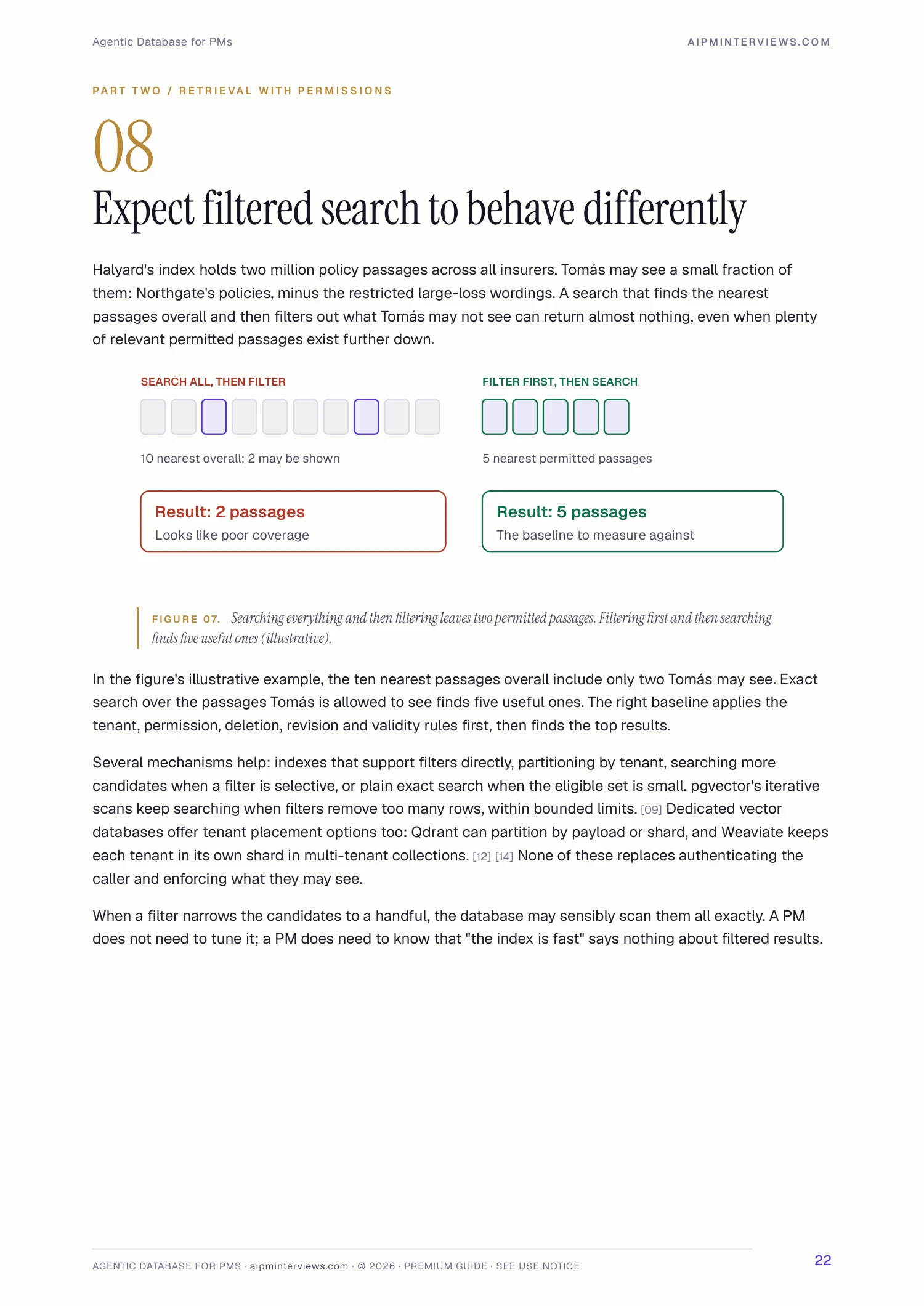
Why searching everything and then filtering by permission can return two passages when five exist.
THE AGENT DATA GUIDE / OCTOBER 2026
Decide what is true, who may see it and how an agent recovers when an action goes wrong.
Authority, permissions, retrieval, memory, knowledge layers, tools and recoverable actions, framed as the data decisions a product manager owns, with a ten-worksheet toolkit for the data PRD.
Already a member? Sign in to download
Guide PDFs and toolkits download with paid Premium while it is active, or with complimentary access we have approved. Days earned through referrals open the rest of the site, not these files.
Most agent incidents that reach a customer are data incidents: an answer from wording that changed last week, a document shown to someone who lost access, a payment sent twice because a reply got lost, a deleted record that came back after a restore. None of them is fixed by a better model. Each is a decision about authority, freshness, permission or recovery that somebody had to make.
This guide follows one fictional claims assistant used by two insurers, from its first retrieval design to a platform choice, a deletion request and three incidents. You learn which system decides each fact, what an agent may remember and change, and how to defend the design to a privacy lawyer, a platform team or an interviewer.
THREE COMPLETE PAGES, FREE TO READ
Each preview is a real page from the PDF. Open one to read it at full size.
Page 22
Why searching everything and then filtering by permission can return two passages when five exist.
Page 43
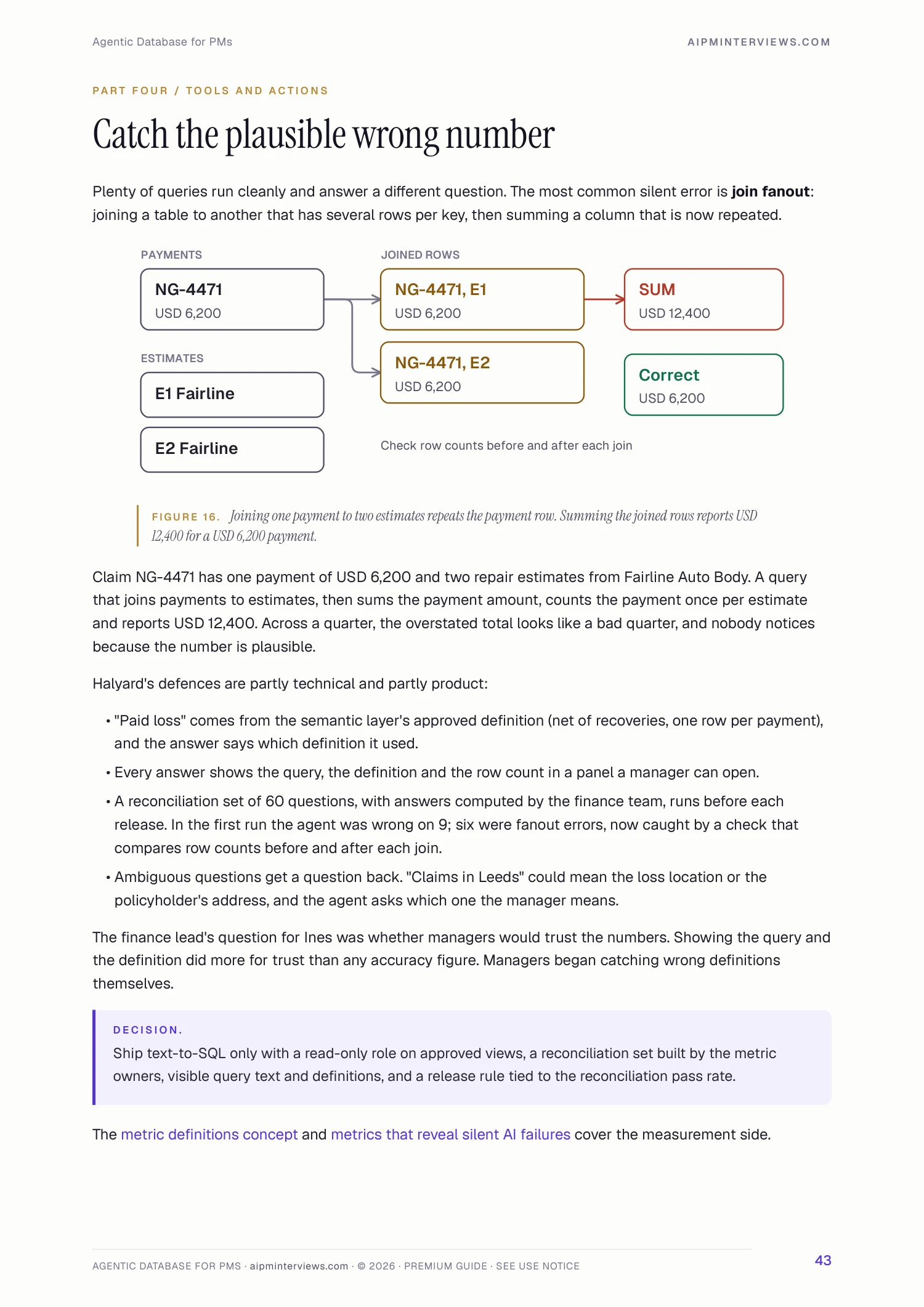
How a join turns one USD 6,200 payment into USD 12,400, and the defences that let managers trust totals.
Page 44
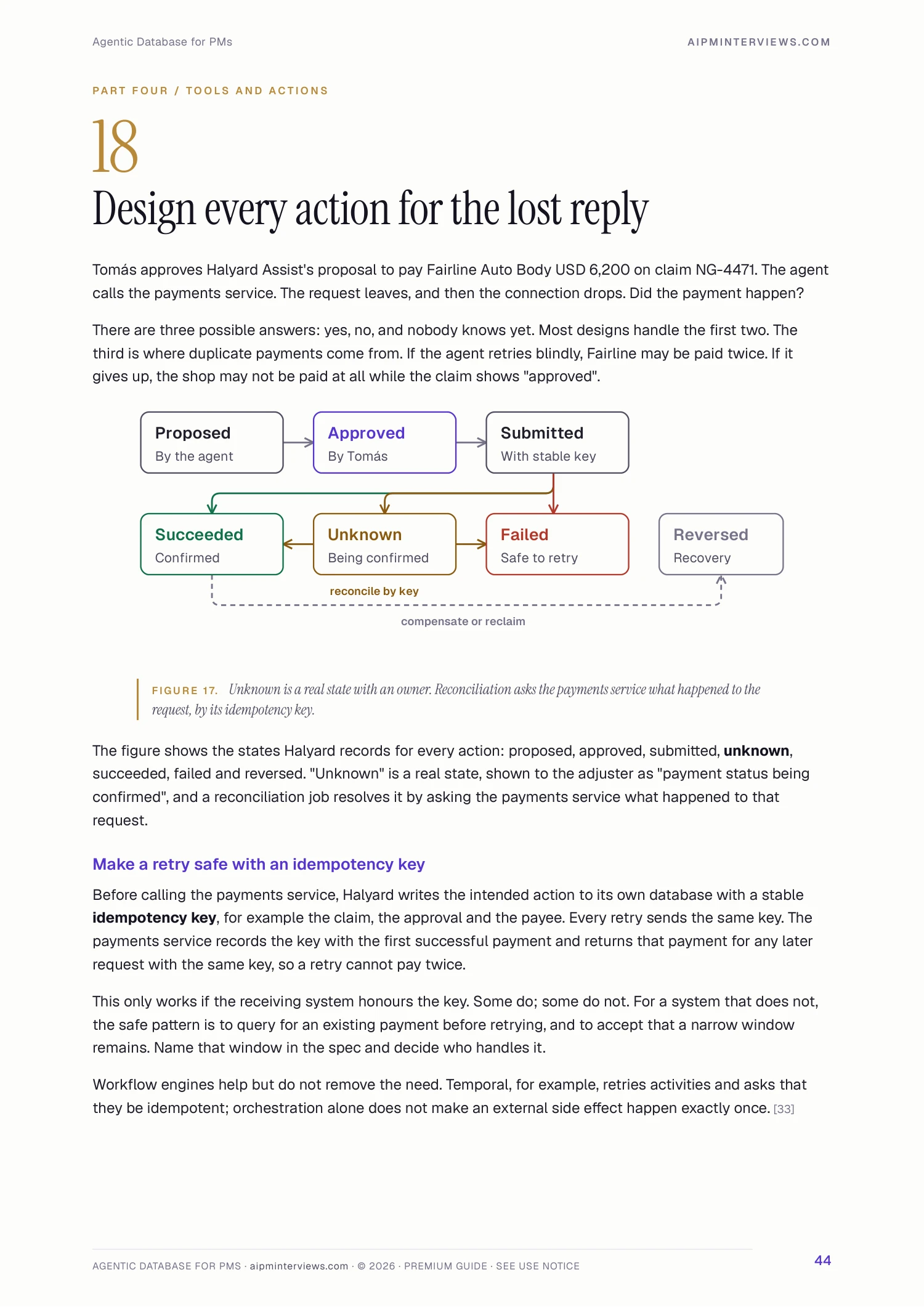
The unknown state, the idempotency key and the re-check that stop a payment going out twice.
31 CHAPTERS / 6 PARTS
Separate answers, recommendations and actions, give every kind of state a contract, learn the database basics that decide outcomes and keep records you can explain.
Start relational, take identity from the caller, question similarity search, filter before ranking, combine methods on evidence and keep the index fresh.
Store memory people can correct, use graphs and time where they earn it, give each knowledge layer one job and keep caches from becoming authority.
Shape tools like the job, fence generated SQL, design every action for the lost reply and resume long tasks without repeating them.
Read the landscape and licences, start small, change safely, price per successful task, benchmark the real request, delete everywhere and release on evidence.
Write the data PRD, work through three incidents, defend the design in a clinic and plan your first six weeks.
WORKED INCIDENTS
Each fictional incident asks what a PM has to answer: which copy took on authority it was never given, who was told, what detection missed and which test now prevents a repeat.
Parser failure / average-lag alert
Find why adjusters quoted an old cap for three hours, and alert on the oldest open record per tenant.
Cache key / missing permission
Put the asker's permission version in every key and re-check permission before any cached read.
Lost reply / timestamp in the key
Build idempotency keys from stable fields only and reconcile payments against approvals every day.
INCLUDED / 14 FILES
The guide ships with ten editable worksheets and three spreadsheets that become the data section of a PRD and the evidence a privacy, platform or customer risk reviewer will ask for.
Start with the job and authority map and the data-contract register. Together they answer the two questions every reviewer asks first: which system decides, and where does every copy live?
PRACTISE NEXT
These questions, concepts and lessons pick up where the chapters leave off. Each link also sits, clickable, in the chapter it supports, and keeps its own access level on the site.
Chapters 1 to 4
Chapters 5 to 10
Chapters 11 to 15
Chapters 16 to 19
Chapters 20 to 27
Chapters 28 to 31
In this guide it is an architecture, not a product: the stores, indexes and controlled interfaces that let an agent find evidence, remember approved facts, resume work and make authorised changes. It does not mean a database with a model inside it.
No. It is written for product managers. It shows a few short schema tables and examples so you can recognise them in a design review, but it never asks you to write a query.
Yes, as decisions: similarity measures, filtered search, hybrid retrieval and reranking, freshness and permission checks, and when a dedicated vector engine earns its place over PostgreSQL with pgvector.
PostgreSQL and pgvector, Qdrant, Weaviate, Mem0, Graphiti, Letta, Neo4j, Feast, Valkey and Redis, MCP servers, Spanner, TiDB, DynamoDB, Cosmos DB, Aurora, Neon, Supabase, BigQuery and more, with 48 sources checked in October 2026 and licence positions dated.
Product, licence and protocol facts are dated October 2026. Each chapter teaches the durable principle first, so the guide stays useful when products and licences change.
14 files: ten editable worksheets from the authority map to the incident review, plus CSV versions of the data-contract register, the platform scorecard and the cost model. Each has one worked example from the guide.
Yes. Chapter 30 is a design clinic of ten prompts with a scoring rubric and worked answers, and every chapter links to related practice questions and concepts on the site. Retrieval, memory and agent safety come up in most AI PM loops.
Yes. The full PDF and toolkit come with paid Premium while it is active, or with complimentary access we have approved, and there is nothing extra to buy. Anyone can read three full sample pages first. Days earned through referrals open the rest of the site, not the guide files.
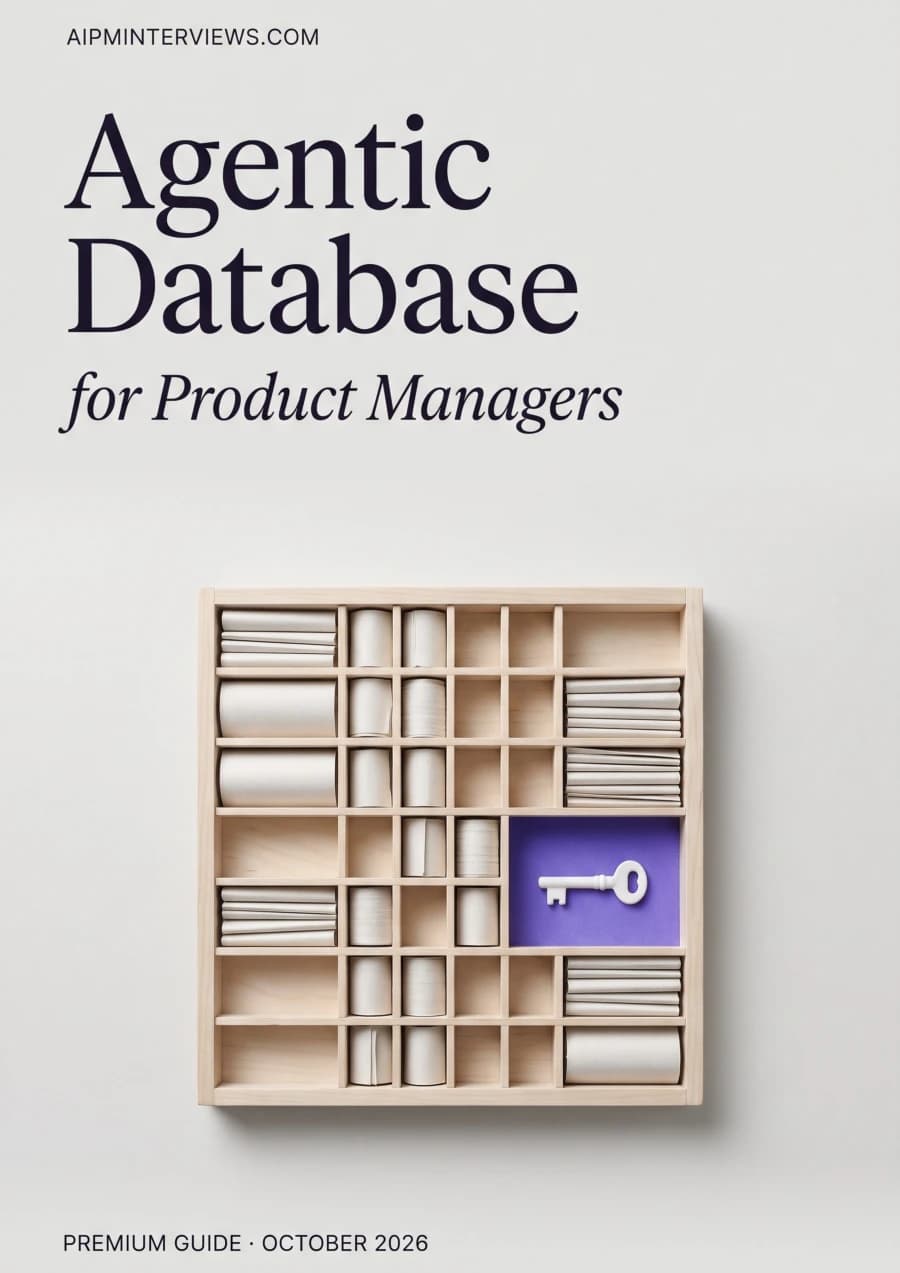
AI tools helped with research, source checks, drafting and the cover art. The diagrams are vector figures written in code. Halyard, its insurer customers and every person in its scenarios are invented. This edition is ready for publisher review, and automated or AI review is no substitute for an independent human editor signing it off.