Page 14
Turn intent into testable requirements
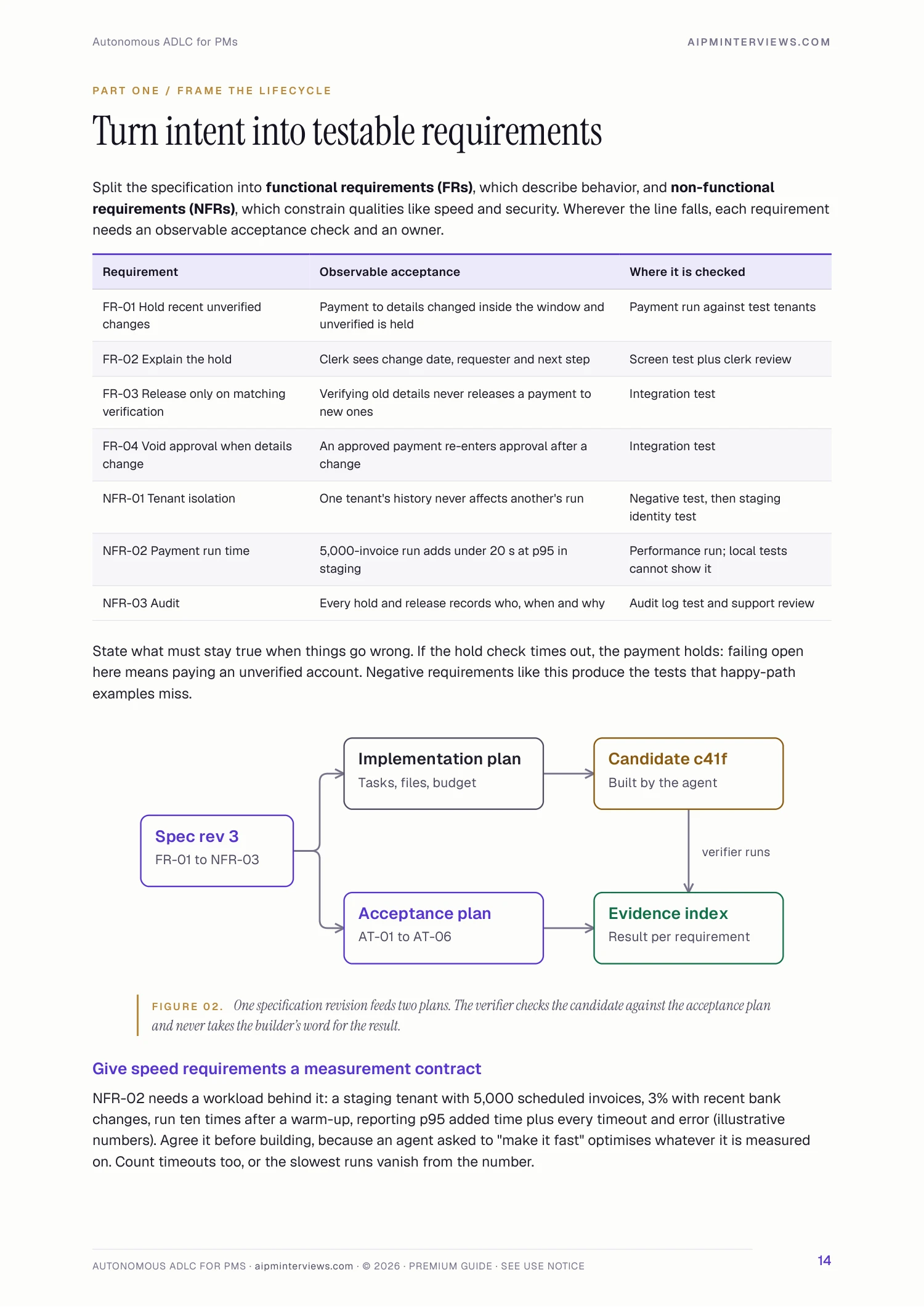
The requirement matrix that ties each FR and NFR to evidence a builder cannot rewrite unnoticed.
THE AGENT-BUILT PRODUCT LIFECYCLE / OCTOBER 2026
Run product development when agents write much of the code, from the PRD to the release gate.
PRDs and specifications agents can build from, acceptance evidence a builder cannot weaken, delegation by action, release gates and cost per accepted change, with a ten-worksheet toolkit.
Already a member? Sign in to download
Guide PDFs and toolkits download with paid Premium while it is active, or with complimentary access we have approved. Days earned through referrals open the rest of the site, not these files.
When coding agents write the code, implementation stops being the slow part. The slow parts become deciding what correct means, verifying that a candidate meets it and releasing it safely. All three are product work, and they now set the pace of the team.
This guide follows one fictional change, a fraud control in an accounts-payable product, from the customer's loss to a PRD, a specification, an agent-built candidate, a protected verifier, a canary and three incidents. You learn which decisions you own at each step and how to defend them to engineering, security and an interviewer.
THREE COMPLETE PAGES, FREE TO READ
Each preview is a real page from the PDF. Open one to read it at full size.
Page 14
The requirement matrix that ties each FR and NFR to evidence a builder cannot rewrite unnoticed.
Page 40
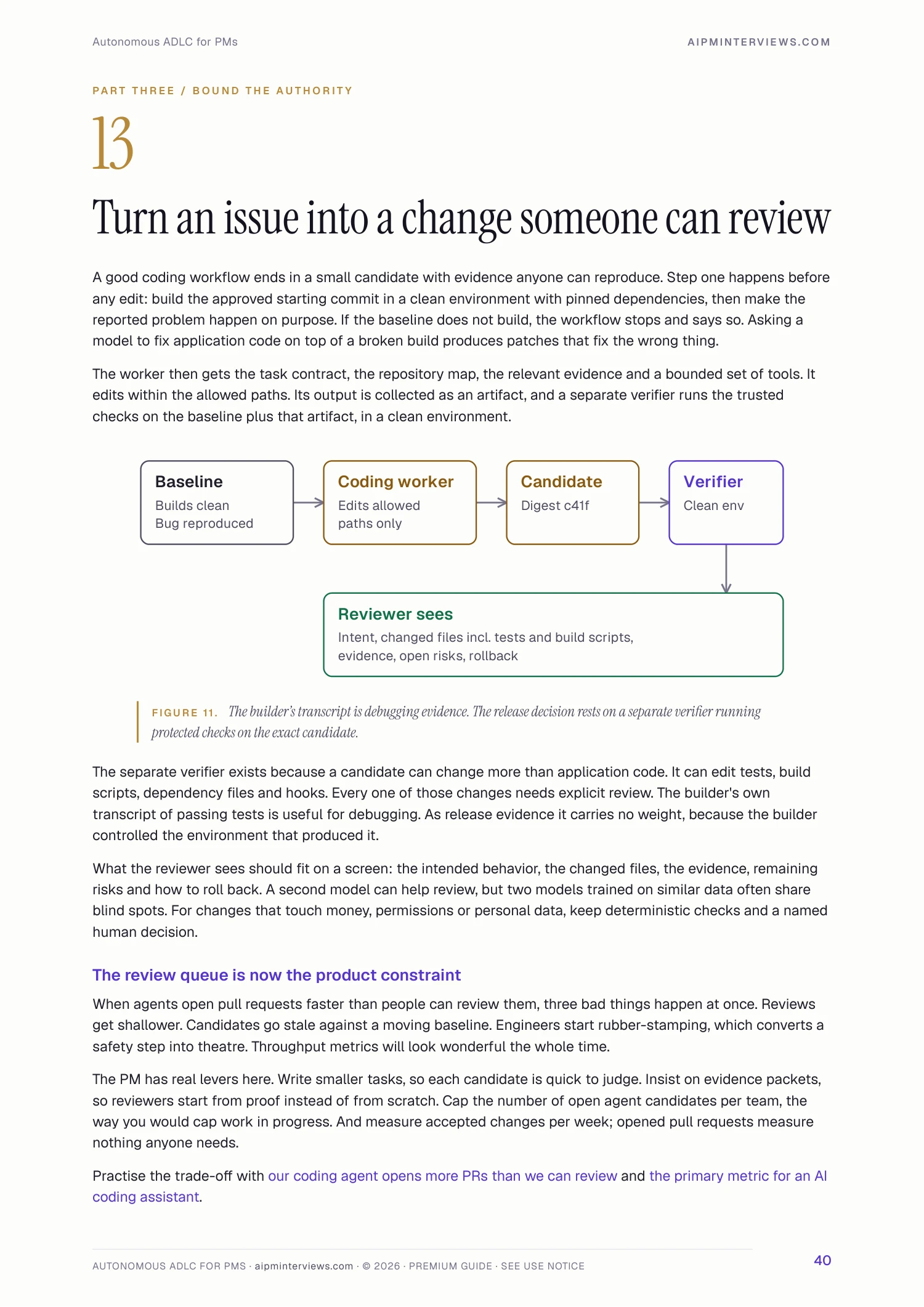
Why the review queue becomes the product constraint, and the levers a PM has over it.
Page 62
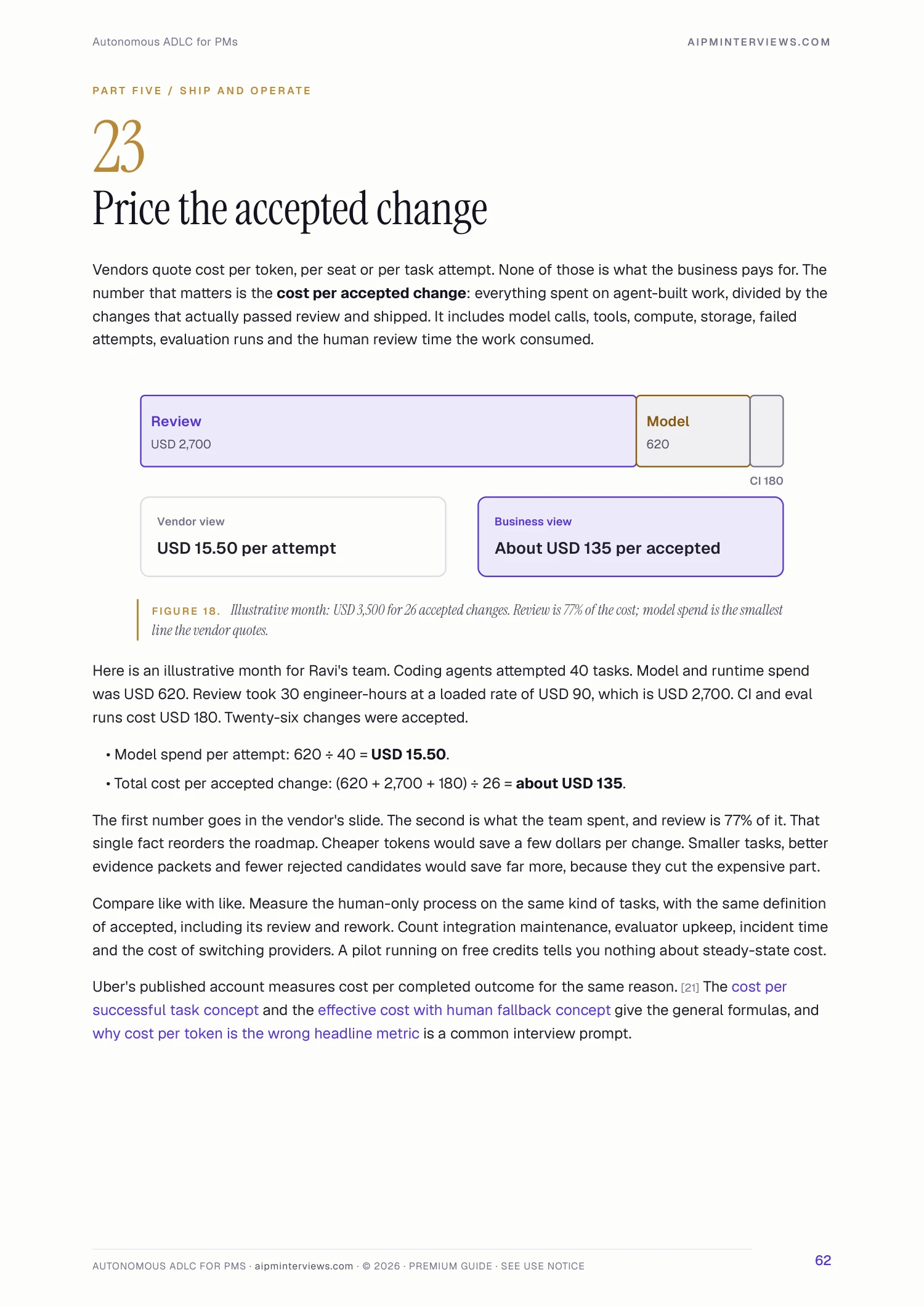
A worked month where review is 77% of the cost, and what that does to the roadmap.
32 CHAPTERS / 6 PARTS
Separate the product loop from the development loop, write the outcome contract and a specification an agent can build from, and decide where authority lives.
Run the same trial against every tool, ship model changes as releases, make the codebase legible to agents and test skills at four levels.
Treat discovery as information, name every operation, isolate execution, keep the review queue healthy, recover unknown outcomes and bind approvals.
Put deterministic checks first, score effects, messages and paths separately, build a resettable practice environment and check what users see.
Threat-model the build, keep decision records and caches honest, price the accepted change, release with a working stop and govern self-improvement.
Assemble the agent-ready PRD, run the readiness review, work through three incidents and defend the design in a review or an interview.
WORKED INCIDENTS
Each fictional incident asks what a PM has to answer: what is known, which record tells the truth, who owns the next step and what changes so it cannot recur.
Protected test / changed expectation
Reject the candidate, move acceptance out of the builder's reach and treat the agent's claim as a question for the requirement owner.
Lost reply / new operation ID
Recover the original operations, release a payment held twice and turn the rerun button into a status check.
Alias rotated / hold rate up
Pin the previous model as a release, rerun the paired eval and make every model identifier exact.
INCLUDED / 14 FILES
The guide ships with ten editable worksheets and three spreadsheets that become the sections of an agent-ready PRD. Each has one worked example from the guide and space for your product.
Start with the outcome contract and the requirement matrix. Between them they answer the two questions every reviewer asks first: what counts as correct, and how will we know?
PRACTISE NEXT
These questions, concepts and lessons pick up where the chapters leave off. Each link also sits, clickable, in the chapter it supports, and keeps its own access level on the site.
Chapters 1 to 4
Chapters 5 to 9
Chapters 10 to 15
Chapters 16 to 19
Chapters 20 to 28
Chapters 29 to 32
In this guide, the agent development lifecycle is the path a change takes from a customer problem to a PRD, a specification, an agent-built candidate, verification, release and operation, with agents doing much of the execution. Vendors use the term in other senses too, and the guide explains which is which.
No. It is written for product managers. It shows a few short task contracts and scenarios so you can recognise them in a review, but it never asks you to configure a coding agent or write tests.
Drafting a PRD with AI is one small part. The guide covers what happens after: requirements an agent can build from, acceptance evidence it cannot weaken, what agents may do on their own, how to release and roll back, and how to measure cost per accepted change.
It summarises published, company-reported accounts from Stripe, Spotify and Uber, and dated documentation from OpenAI, Anthropic, Google, AWS, Microsoft and others, with 39 sources checked in October 2026. Every company claim is labelled as company-reported.
Product and model facts are dated October 2026 and labelled. Each chapter teaches the durable product principle first, so the guide stays useful when tools change.
14 files: ten editable worksheets from outcome contract to incident review, plus CSV versions of the requirement matrix, the tool trial scorecard and the metrics spec. Each has one worked example from the guide.
Yes. Chapter 32 has ten review prompts with a scoring rubric, and every chapter links to related practice questions and concepts on the site. Coding agents, evals and release decisions come up often in AI PM loops.
Yes. The full PDF and toolkit come with paid Premium while it is active, or with complimentary access we have approved, and there is nothing extra to buy. Anyone can read three full sample pages first. Days earned through referrals open the rest of the site, not the guide files.
AI tools helped with research, source checks, drafting and the cover art. The diagrams are vector figures written in code. Tallyhouse, Bramwell Foods and every person in its scenarios are invented. This edition is ready for publisher review, and automated or AI review is no substitute for an independent human editor signing it off.