Page 17
Give one intended action one identity
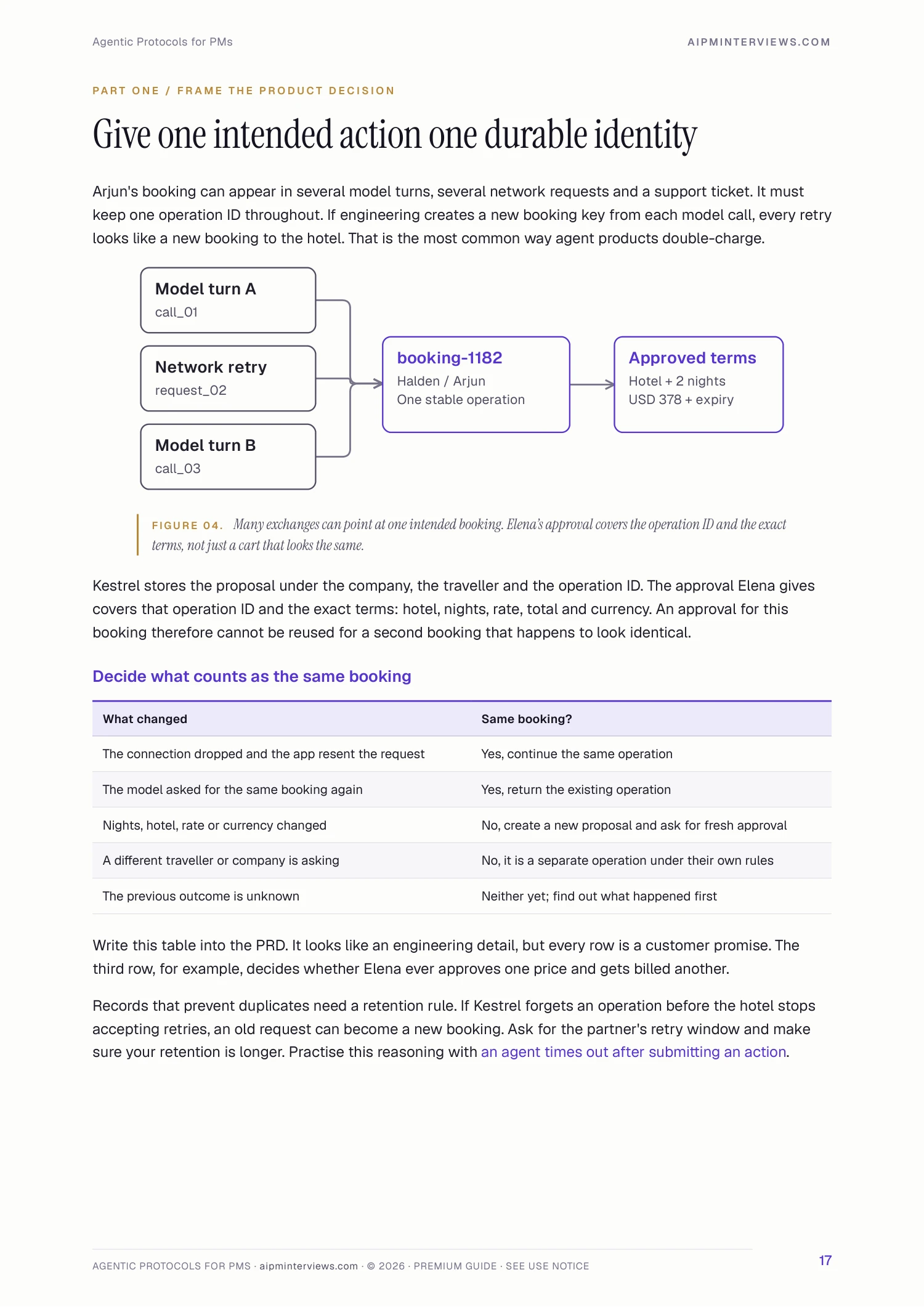
Why retries double-charge customers, and the table that decides when two requests are the same booking.
THE AGENT INTEGRATION GUIDE / OCTOBER 2026
Decide what your agent may connect to, what it may do, and what users see when it goes wrong.
MCP, A2A, agent interfaces, approvals, agentic commerce and payments, explained as the decisions a product manager owns, with a ten-worksheet toolkit for the PRD.
Already a member? Sign in to download
Guide PDFs and toolkits download with paid Premium while it is active, or with complimentary access we have approved. Days earned through referrals open the rest of the site, not these files.
Every agent product hands work across boundaries. A model suggests a tool call, an assistant calls your server, a partner's agent takes over part of the job, and a merchant or payment provider makes the change in the real world. Each handover runs on a contract, and every contract leaves some decisions to your product.
This guide follows one fictional booking through every one of them. You learn what each protocol promises, what it leaves to you, and how to write the requirement, challenge the design and explain the risk to a customer, a security reviewer or an interviewer.
THREE COMPLETE PAGES, FREE TO READ
Each preview is a real page from the PDF. Open one to read it at full size.
Page 17
Why retries double-charge customers, and the table that decides when two requests are the same booking.
Page 53
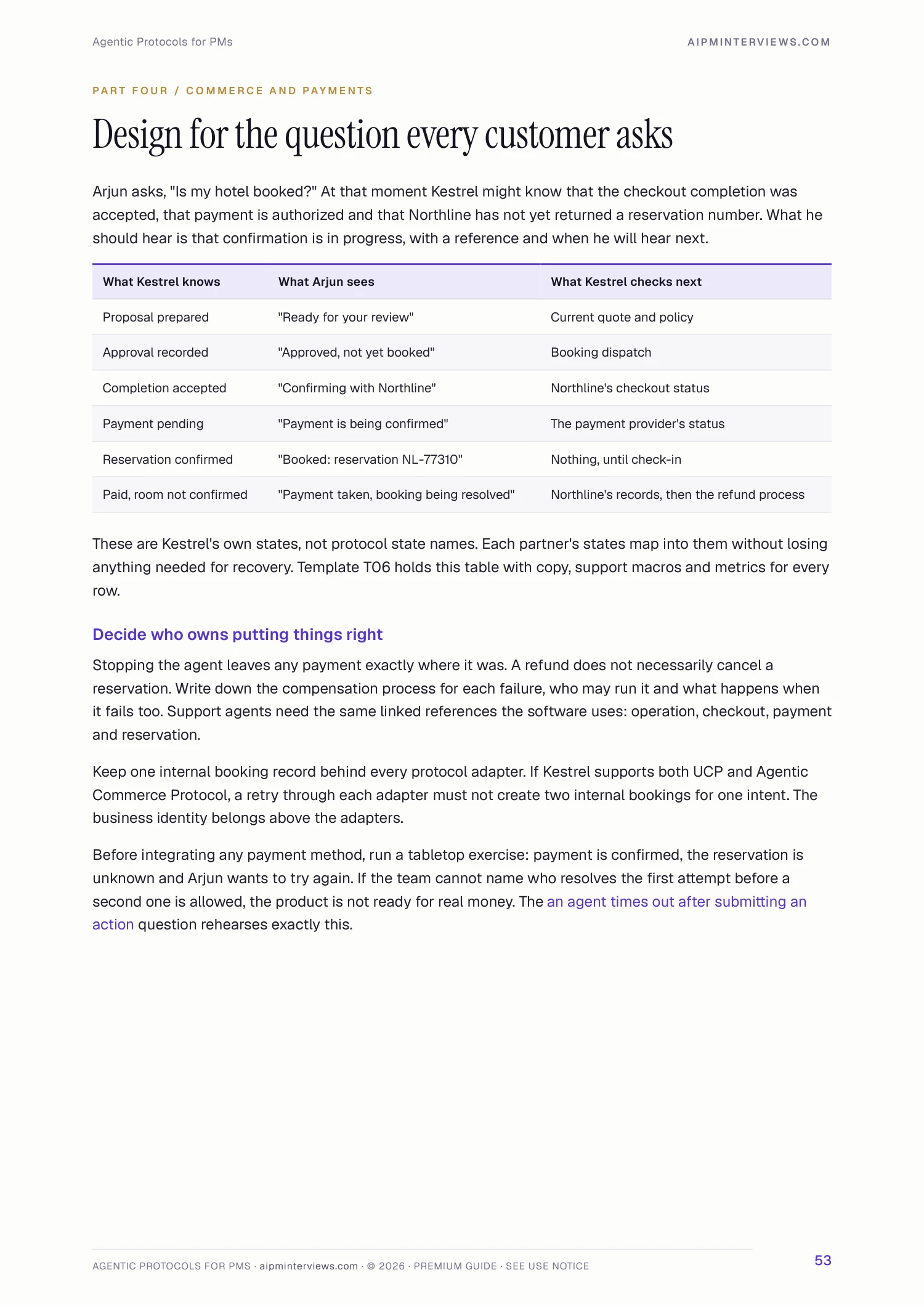
Map every purchase state to what the user reads and what the product checks next.
Page 79
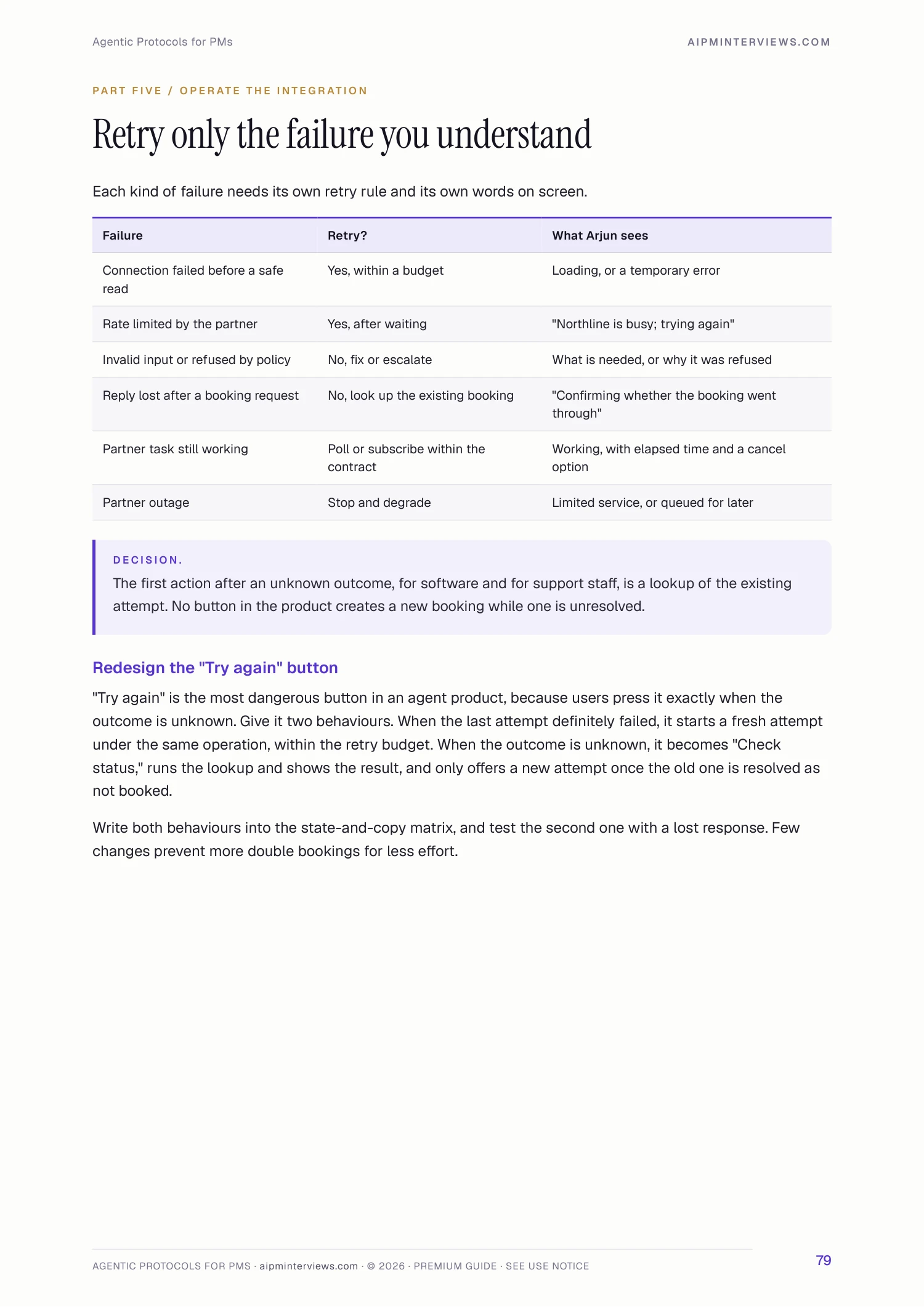
Retry only the failures you understand, and turn the most dangerous button into a status check.
32 CHAPTERS / 6 PARTS
Write the outcome contract, read the protocol landscape, know what the wire means for users, and keep the model proposing while the product decides.
Decide whether to ship an MCP server, plan for versions, design authorization and interruptions, work with partner agents and build an interface that tells the truth.
Know whose identity the agent carries, and make an approval mean one exact action, even when requests race.
Map an agent-led purchase end to end, then evaluate UCP, Agentic Commerce Protocol, AP2 mandates, x402 and the wider payment stack.
Choose runtimes by how they fail, bound browser agents, run the integration catalog and kill switch, design for unknown outcomes, measure honestly and launch in stages.
Write the protocol PRD, run a readiness review, work through three incidents and defend the design in a review or an interview.
WORKED INCIDENTS
Each fictional incident asks the questions a PM owns: what is known, which record is authoritative, what the user should be told, and what changes so it cannot happen again.
Lost response / one intended booking
The hotel may already have booked the room. Recover the existing operation and redesign the button that would have booked it twice.
Correct signature / wrong registration
Find why a genuine update changed another customer's task, scope the impact from evidence and tell admins precisely what happened.
Stale approval / changed total
Refuse the changed booking, ask for fresh approval and never tell a user they were not charged until the payment record proves it.
INCLUDED / 13 FILES
The guide ships with ten editable worksheets and two spreadsheets that turn each chapter into a section of your protocol PRD. Each has one worked example row from the guide and blank rows for your product.
Start with the decision record and the state-and-copy matrix. Between them they answer the two questions every reviewer asks first: why this protocol, and what does the user see when it fails?
PRACTISE NEXT
These questions, concepts and lessons pick up where the chapters leave off. Each link also sits, clickable, in the chapter it supports, and keeps its own access level on the site.
Chapters 1 to 5
Chapters 6 to 13
Chapters 14 and 15
Chapters 16 to 21
Chapters 22 to 28
Chapters 29 to 32
They are the contracts at the boundaries of an agent product: model to tool calls, assistants to capability servers (MCP), your software to a partner's agent (A2A), agents to user interfaces (AG-UI, A2UI, MCP Apps), and agents to checkout and payment systems (UCP, Agentic Commerce Protocol, AP2, x402, MPP). The guide explains which boundary each serves and which decisions it leaves to your product.
No. It is written for product managers and explains each protocol in terms of user experience, risk and requirements. It shows a few short protocol messages so you can recognise them in a design review, but never asks you to implement anything.
MCP is how an assistant reaches what your product offers: its tools, its data and its prompt templates. A2A is how your software hands a longer job to an agent that someone else runs. Neither one gives an agent the right to act for a user, so the guide follows identity, approval and the business record across both.
Both names exist. Agentic Commerce Protocol handles checkout and delegated payment; Agent Client Protocol connects coding agents to editors; the earlier Agent Communication Protocol now points users to A2A. The guide uses full names and exact versions throughout.
It describes protocols as of October 2026, with exact versions and 86 sources checked on 25 October 2026. Protocols change quickly, so every dated fact is labelled and each chapter teaches the durable product principle before the version detail.
13 files: ten editable worksheets covering the protocol PRD from decision record to support handover, plus CSV versions of the state-and-copy matrix and the metrics spec. Each has one worked example from the guide.
Yes. Chapter 32 is a review clinic of ten prompts with a scoring rubric, and every chapter links to related practice questions and concepts on the site. Agent design, MCP and the safety of agents that act are common topics in AI PM loops.
Yes. The full PDF and toolkit come with paid Premium while it is active, or with complimentary access we have approved, and there is nothing extra to buy. Anyone can read three full sample pages first. Days earned through referrals open the rest of the site, not the guide files.
AI tools helped with research, source checks, drafting and the cover art. The diagrams are vector figures written in code, not generated images. Kestrel, and every person and company in its scenarios, is invented. This edition is ready for publisher review, and automated or AI review is no substitute for an independent human editor signing it off.