Page 21
Fight approval fatigue with design
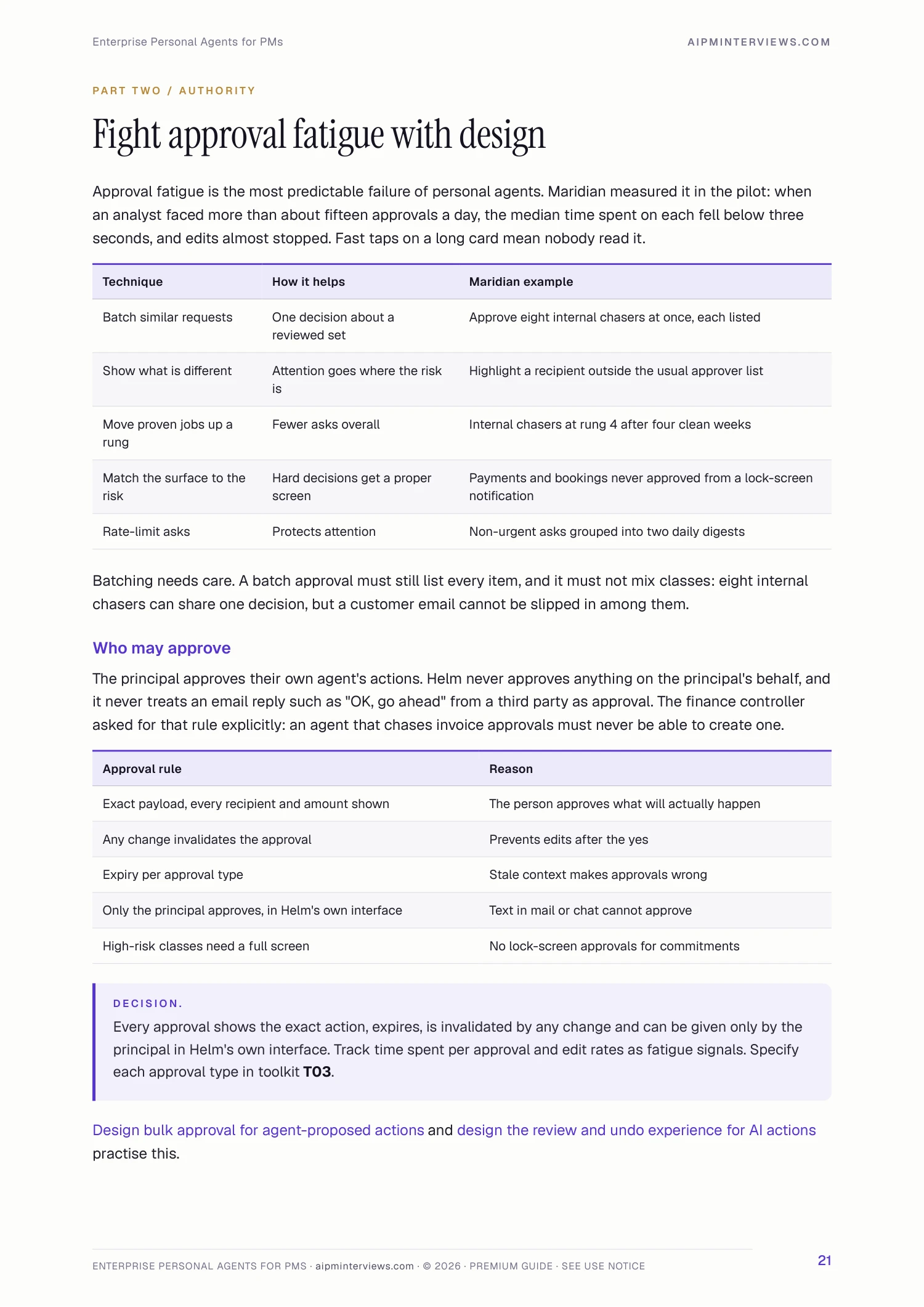
Why people stop reading approvals after about fifteen a day, and five techniques that bring attention back.
THE PERSONAL AGENT GUIDE / OCTOBER 2026
Build agents that act for one employee, with authority, approvals and memory people will trust.
Jobs and autonomy, delegated access, approvals, prompt injection, memory, notifications, value and governance for agents that work for one employee, with a ten-worksheet toolkit for the agent PRD.
Already a member? Sign in to download
Guide PDFs and toolkits download with paid Premium while it is active, or with complimentary access we have approved. Days earned through referrals open the rest of the site, not these files.

A personal agent reads one employee's mail and calendar, drafts their replies, chases their approvals and rebooks their travel. It acts with that person's access, inside rules their employer sets, and it writes in their name. Whether people hand it real work depends less on the model than on how much authority it has, what it asks before acting and what it remembers.
This guide follows one fictional company rolling out a personal agent to 6,000 employees across Europe, India and the US, from choosing the first three jobs to a works council review, a month-end incident and a cancelled flight at 1:40 a.m. You learn the decisions a PM owns and how to defend them to security, legal, employee representatives and an interviewer.
THREE COMPLETE PAGES, FREE TO READ
Each preview is a real page from the PDF. Open one to read it at full size.
Page 21
Why people stop reading approvals after about fifteen a day, and five techniques that bring attention back.
Page 29
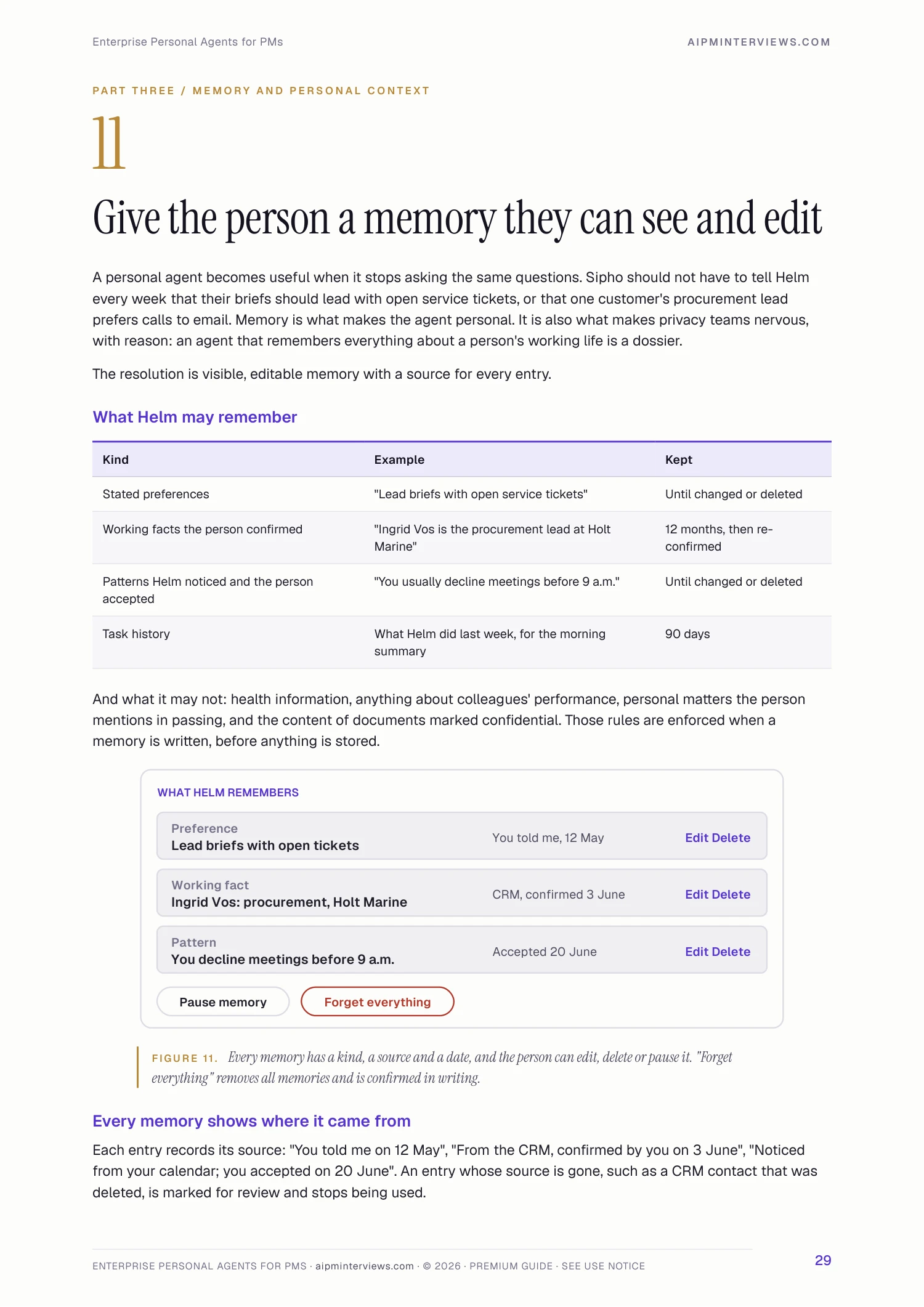
What a personal agent may remember, what it never stores, and the memory page that makes it trusted.
Page 65
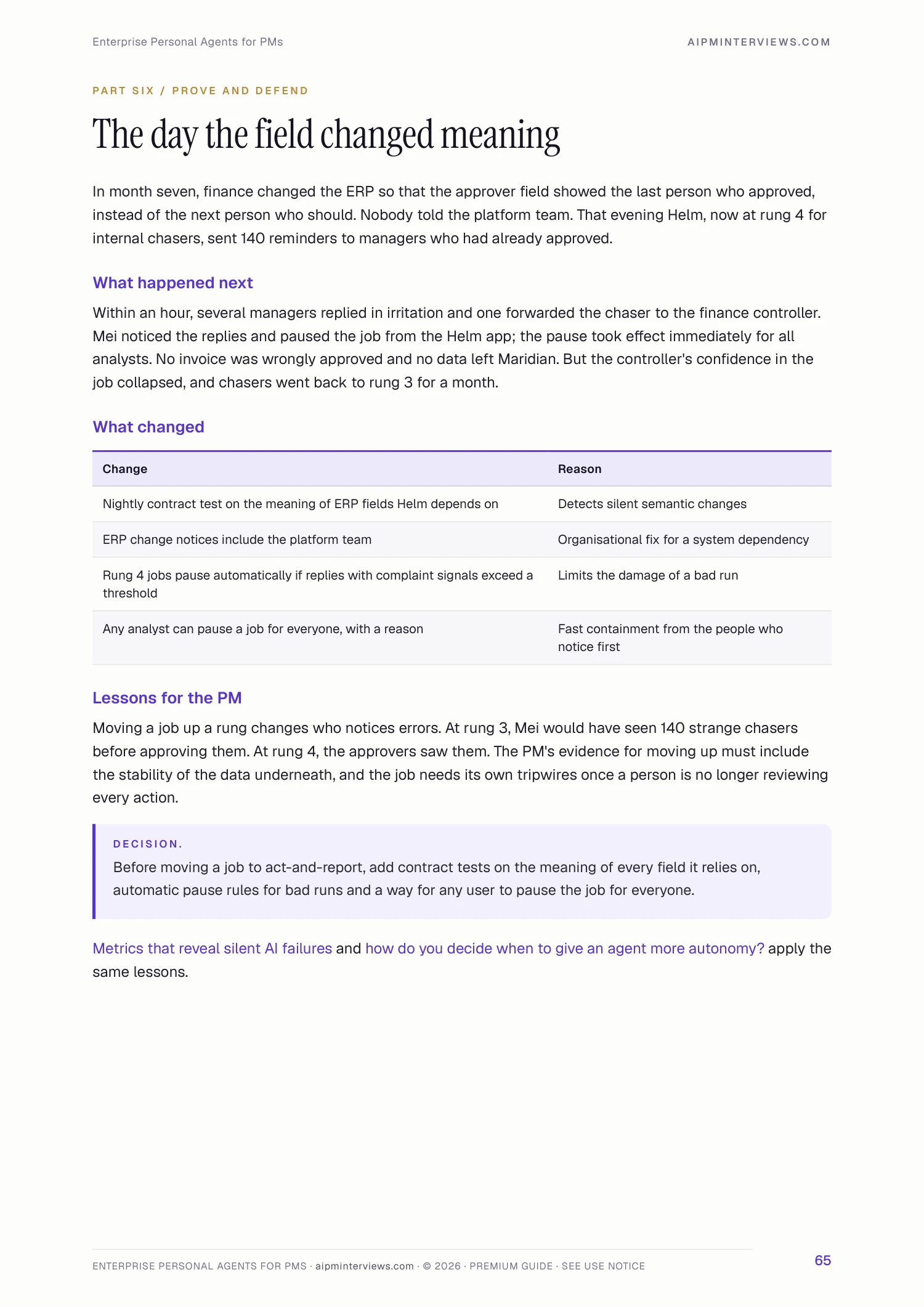
How a quiet ERP change sent 140 wrong chasers, and the tripwires a job needs before it acts on its own.
31 CHAPTERS / 6 PARTS
Know what a personal agent is, read the platform landscape, choose jobs people will hand over and find the objections before the review does.
Act with less than the person's access, put a gatekeeper outside the model, design approvals people read, contain injection, register connectors and bound unattended work.
Give people a memory they can see and edit, personalise without surprise, assemble context by rule and plan for role changes and leavers.
Interrupt only when it is worth it, stay one assistant across surfaces, design out misuse with care for the person and keep data in its region.
Price per person and per job, measure value from system data, evaluate the jobs, keep an audit, pass governance, roll out in waves and operate a service.
Work through three cases, write the agent PRD, defend the design in a clinic and plan your first six weeks.
WORKED INCIDENTS
Each fictional case follows one job from design to its first serious failure, and asks what a PM has to answer: what the agent assumed, who noticed, how it was contained and what changed.
Ambiguous data / visible assumption
Resolve accounts from email domains before names, and put the riskiest assumption at the top of the brief.
Act and report / silent ERP change
Add contract tests on field meanings, automatic pause rules and a way for any user to stop a job for everyone.
Lost reply / new request identifier
Build request identifiers from stable fields, show unknown outcomes as unknown and reconcile bookings daily.
INCLUDED / 14 FILES
The guide ships with ten editable worksheets and three spreadsheets that become the sections of an agent PRD and the review packet security, data protection, legal and employee representatives sign.
Start with the job and autonomy map and the delegation matrix. Together they answer the two questions every reviewer asks first: what will it do on its own, and with whose access?
PRACTISE NEXT
These questions, concepts and lessons pick up where the chapters leave off. Each link also sits, clickable, in the chapter it supports, and keeps its own access level on the site.
Chapters 1 to 4
Chapters 5 to 10
Chapters 11 to 14
Chapters 15 to 18
Chapters 19 to 25
Chapters 26 to 31
An AI agent that works on behalf of one employee: reading their mail and calendar, drafting their messages, chasing their approvals and handling tasks such as travel changes, with that person's narrowed access and inside rules their employer sets.
No. It is written for product managers and explains delegation, approvals, injection and memory through the decisions you own. It shows a short policy rule and an approval card so you can recognise them in a review, but never asks you to configure anything.
A shared assistant answers anyone with the company's voice. A personal agent acts as one person, with their access, and its mistakes land on their name. That changes how you design authority, approvals, memory and measurement, and which stakeholders you need on side.
Microsoft 365 and Agent 365, Google's Gemini Enterprise Agent Platform, AWS Bedrock AgentCore, OpenAI's Agents SDK, Anthropic memory controls, MCP and A2A, the EU AI Act and digital omnibus, India's DPDP Rules and the NIST AI RMF, with 37 sources checked in October 2026.
Platform, protocol and regulatory facts are dated October 2026 and several cited standards are drafts. Each chapter teaches the durable product decision first, so the guide stays useful when products change.
14 files: ten editable worksheets from the job and autonomy map to the incident review, plus CSV versions of the delegation matrix, the connector register and the value plan. Each has one worked example from the guide.
Yes. Chapter 30 is a design clinic of ten prompts with a scoring rubric and worked answers, and every chapter links to related practice questions on the site. Email agents, travel agents and approval design are common AI PM interview cases.
Yes. The full PDF and toolkit come with paid Premium while it is active, or with complimentary access we have approved, and there is nothing extra to buy. Anyone can read three full sample pages first. Days earned through referrals open the rest of the site, not the guide files.
AI tools helped with research, source checks, drafting and the cover art. The diagrams are vector figures written in code. Maridian Group, Helm and every person in its scenarios are invented. This edition is ready for publisher review, and automated or AI review is no substitute for an independent human editor signing it off.