Page 27
Size the hardware from memory and peak load
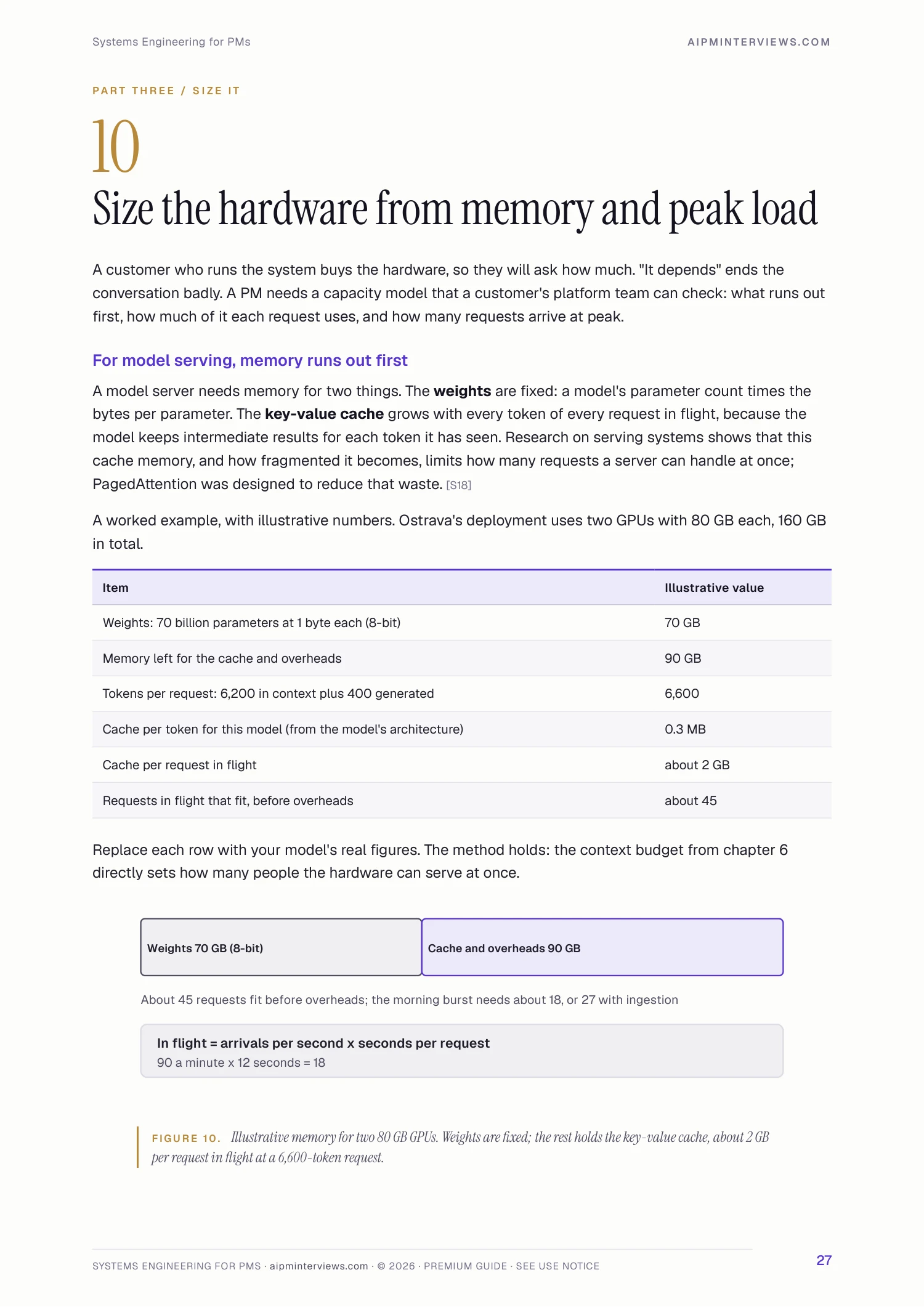
A worked GPU estimate a customer can check: weights, cache per request, the morning burst and the idle months.
THE AI SYSTEMS GUIDE / OCTOBER 2026
Ship AI that runs in the customer's own cloud, data centre or offline site, and keeps its promise there.
Outcome contracts, the least machinery that works, data contracts, capacity, latency budgets, evaluation with intervals, releases, offline mode and handoff, with a ten-worksheet toolkit for the deployment PRD.
Already a member? Sign in to download
Guide PDFs and toolkits download with paid Premium while it is active, or with complimentary access we have approved. Days earned through referrals open the rest of the site, not these files.

Many enterprise customers will only buy AI that runs in their own environment: a utility's cloud tenant, a bank's data centre, a plant floor with no internet. Then the product is the whole package: what it promises, what it needs from the customer, how it behaves when parts fail and how the customer's engineers keep it healthy.
This guide follows one fictional vendor through four customer deployments, from rewriting a request as a measurable promise to sizing GPUs, dividing a latency budget, judging answers with honest intervals, shipping releases a customer can inspect, running offline and handing over. You learn the decisions a PM owns and how to defend them to customer architects and in interviews.
THREE COMPLETE PAGES, FREE TO READ
Each preview is a real page from the PDF. Open one to read it at full size.
Page 27
A worked GPU estimate a customer can check: weights, cache per request, the morning burst and the idle months.
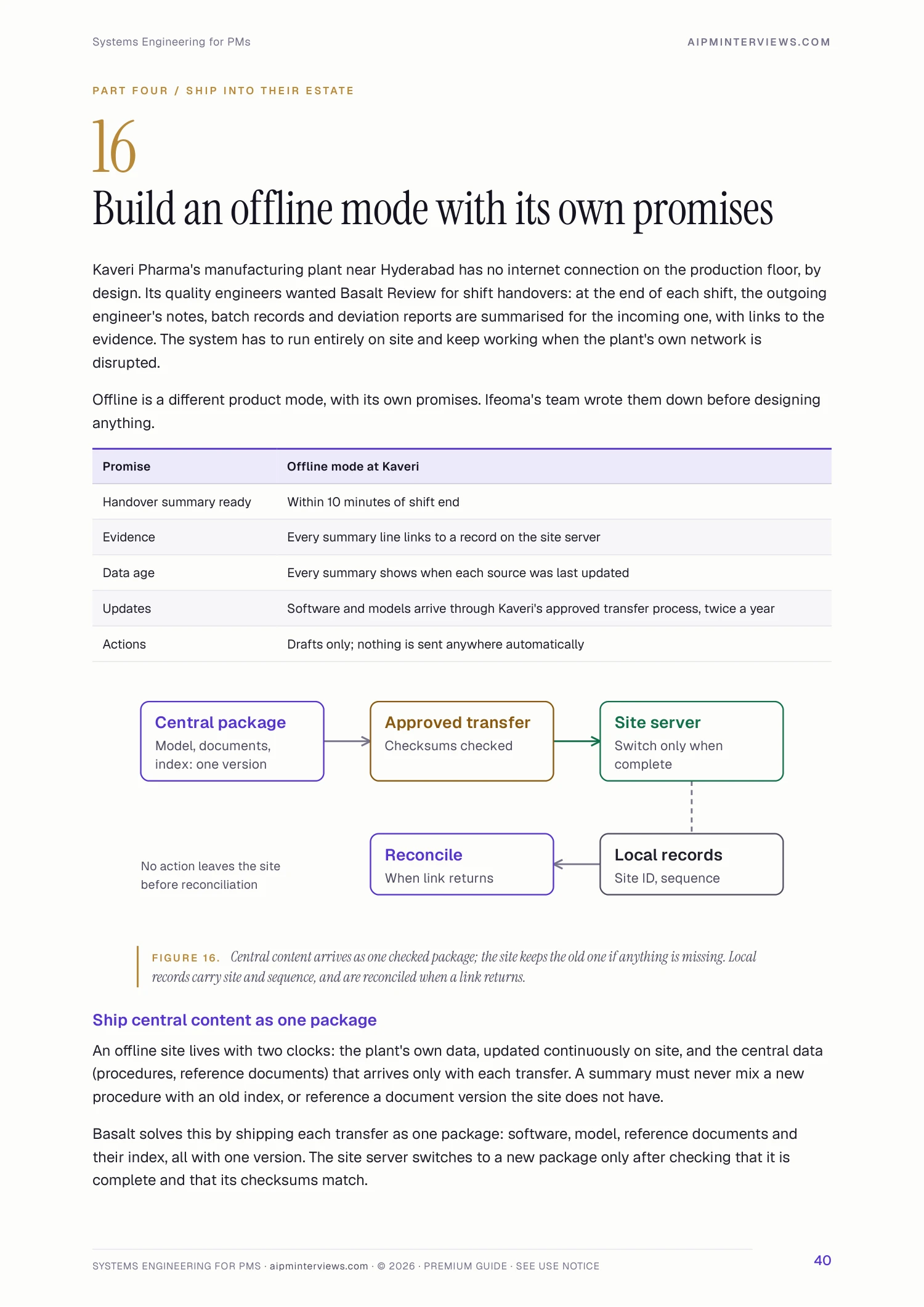
Page 40
What an AI system promises on a plant floor with no internet, and how one package and visible freshness keep it.
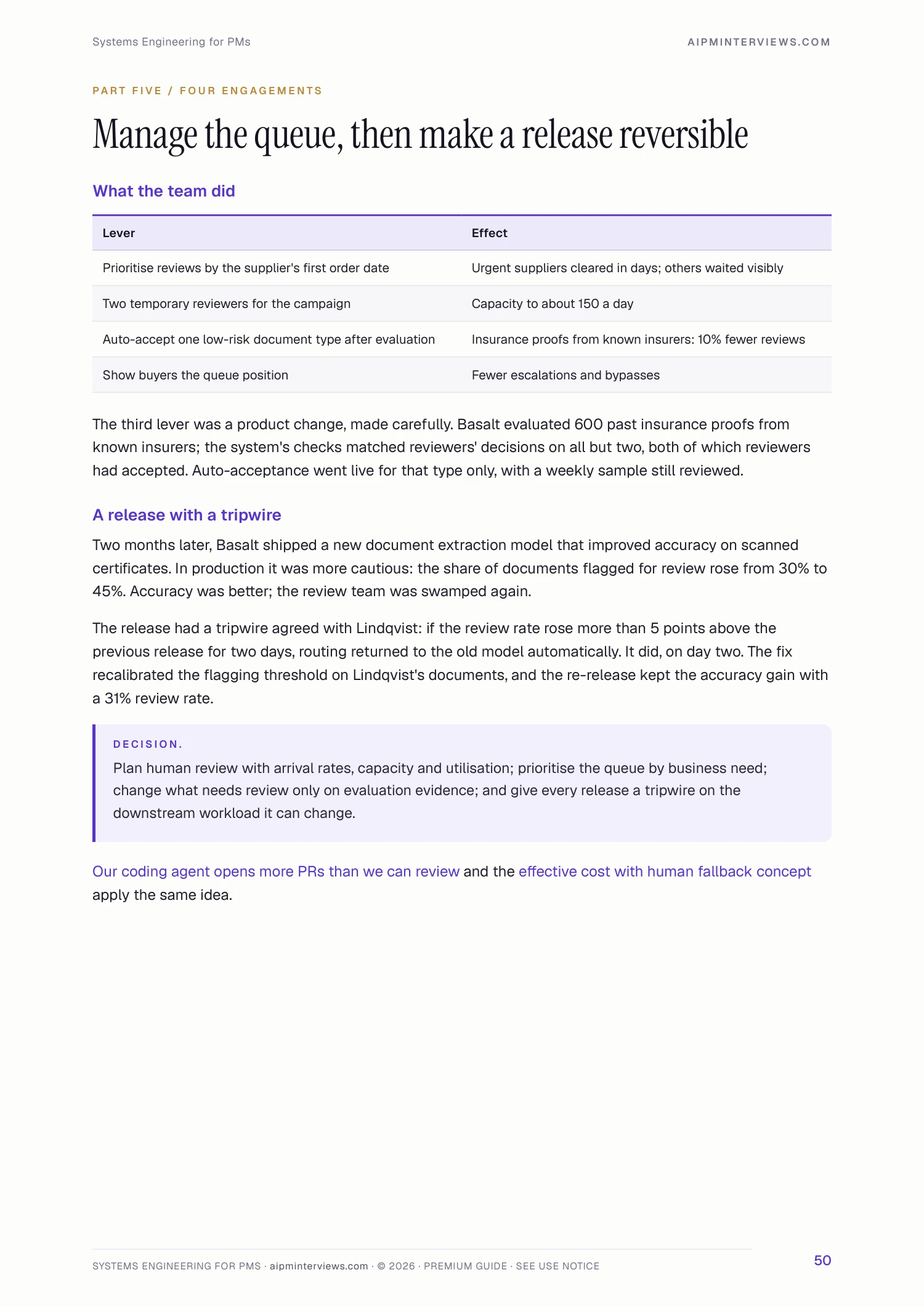
Page 50
How a more accurate model swamped a review team, and the tripwire that rolled it back on day two.
25 CHAPTERS / 6 PARTS
Rewrite the request as a measurable promise, pick the least machinery that keeps it, agree data dependencies and keep evidence intact to the answer.
Search only what the asker may see, give the model an auditable context, treat models as replaceable services, write safely and keep permissions out of the model.
Size hardware from memory and peak load, split the deadline across every step, reuse results only where valid and measure with intervals.
Decide which environments you support, ship inspectable releases, build an offline mode, monitor the promise and hand over what the customer has practised.
Follow a cloud tenant, a review queue, an offline plant floor and an overnight batch through their first serious failure.
Write the deployment PRD, defend the design in a clinic and plan your first six weeks.
WORKED INCIDENTS
Each fictional deployment runs somewhere different and fails differently. Each asks what a PM must answer: what was promised, what broke, which rule caught it and what changed.
Customer cloud / mapping out of step
Version reference tables with the release, check versions at startup and keep a canary slice for every past failure.
Hosted / review rate up 15 points
Plan review capacity like a service and give every release a tripwire on the work it creates downstream.
Offline site / eight-minute clock drift
Order events by each source's sequence, sync plant clocks and show drift before it misleads.
INCLUDED / 14 FILES
The guide ships with ten editable worksheets and three spreadsheets that become the sections of a deployment PRD and the documents a customer's compliance, platform and security teams will ask for.
Start with the outcome contract and the capacity model. Together they answer the two questions every customer asks first: what exactly are you promising, and what will it take to run?
PRACTISE NEXT
These questions, concepts and lessons pick up where the chapters leave off. Each link also sits, clickable, in the chapter it supports, and keeps its own access level on the site.
Chapters 1 to 4
Chapters 5 to 9
Chapters 10 to 13
Chapters 14 to 18
Chapters 19 to 22
Chapters 23 to 25
The decisions that make an AI system predictable in someone else's environment: the promise and how it is measured, the least machinery that keeps it, the capacity and latency it needs, how it fails, and how a release reaches a customer who controls the servers.
No. It is written for product managers. It includes a few short calculations with round numbers, such as a GPU estimate and a confidence interval, so you can follow and challenge an engineer's numbers, but it never asks you to write code.
No. It covers four deployment profiles: vendor-hosted, the customer's own cloud tenant, the customer's data centre and offline sites. Most of the guide applies to any AI product with enterprise customers.
Google's SRE books, AWS guidance, PostgreSQL, pgvector, Kubernetes, OpenTelemetry, OWASP, Temporal, vLLM and research papers on retrieval, LoRA, QLoRA and model serving, with 31 sources checked on 27 October 2026. Research is cited for the mechanism it shows, under the authors' conditions.
Product facts are dated October 2026. The methods it teaches, sizing from peak and memory, budgeting deadlines and judging with intervals, outlast any particular model or GPU.
14 files: ten editable worksheets from the outcome contract to the handoff plan, plus CSV versions of the data contract, the capacity model and the evaluation plan. Each has one worked example from the guide.
Yes. Chapter 24 is a design clinic of ten system design prompts with a rubric and worked answers, and every chapter links to related practice questions. Capacity, latency and self-hosting trade-offs come up in platform and enterprise AI PM loops.
Yes. The full PDF and toolkit come with paid Premium while it is active, or with complimentary access we have approved, and there is nothing extra to buy. Anyone can read three full sample pages first. Days earned through referrals open the rest of the site, not the guide files.
AI tools helped with research, source checks, drafting and the cover art. The diagrams are vector figures written in code. Basalt Labs, its four customers and every person in its scenarios are invented. This edition is ready for publisher review, and automated or AI review is no substitute for an independent human editor signing it off.